PUBLICATIONS
CASE STUDIES AND
RESEARCH REPORTS
2026
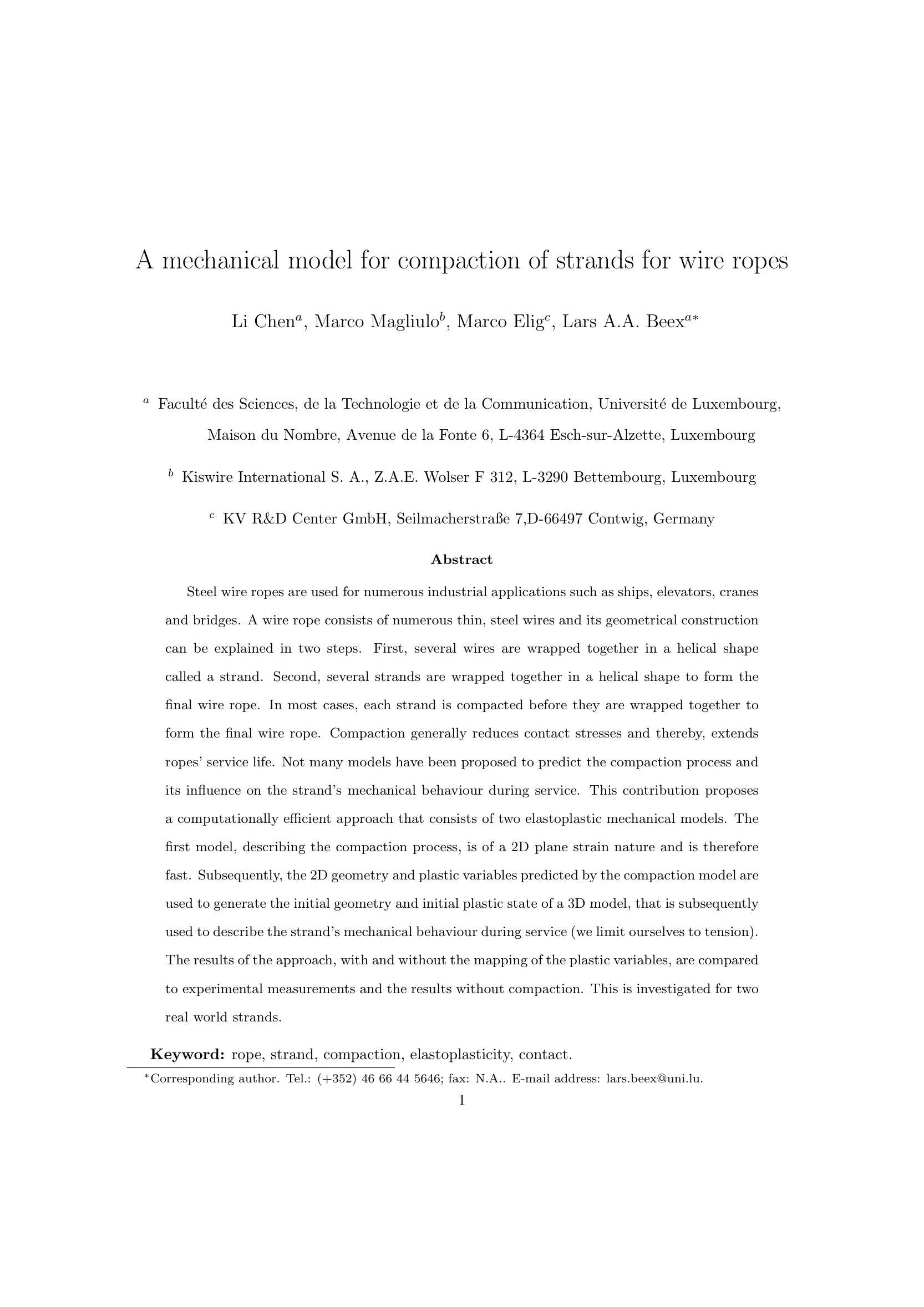
The Optimal Use of Bending Fatigue Testing Machines for Ropes: A Comparative Study
How comparable are the results obtained from different bending fatigue testing machines in practice? The paper "The Optimal Use of Bending Fatigue Testing Machines for Ropes: A Comparative Study" investigates three different testing principles under harmonized boundary conditions.
Despite identical rope construction, loading conditions, and geometry, significant differences in operating life and overall service life were observed. The results demonstrate that, in addition to nominal test parameters, factors such as machine design, load transfer mechanisms, bending lengths, and interactions between consecutive bending zones can influence fatigue behavior.
The study therefore provides an important basis for improving the comparability of test results, as well as for the future standardization and reproducible assessment of wire rope bending fatigue.
Authors
Marco Elig, KV R&D Center GmbH, Contwig Germany
Dr.-Ing. Marc Fuhrmann, KV R&D Center GmbH, Contwig Germany
Dr.-Ing. Martin Anders, Technische Universität Dresden, Dresden Germany
2025
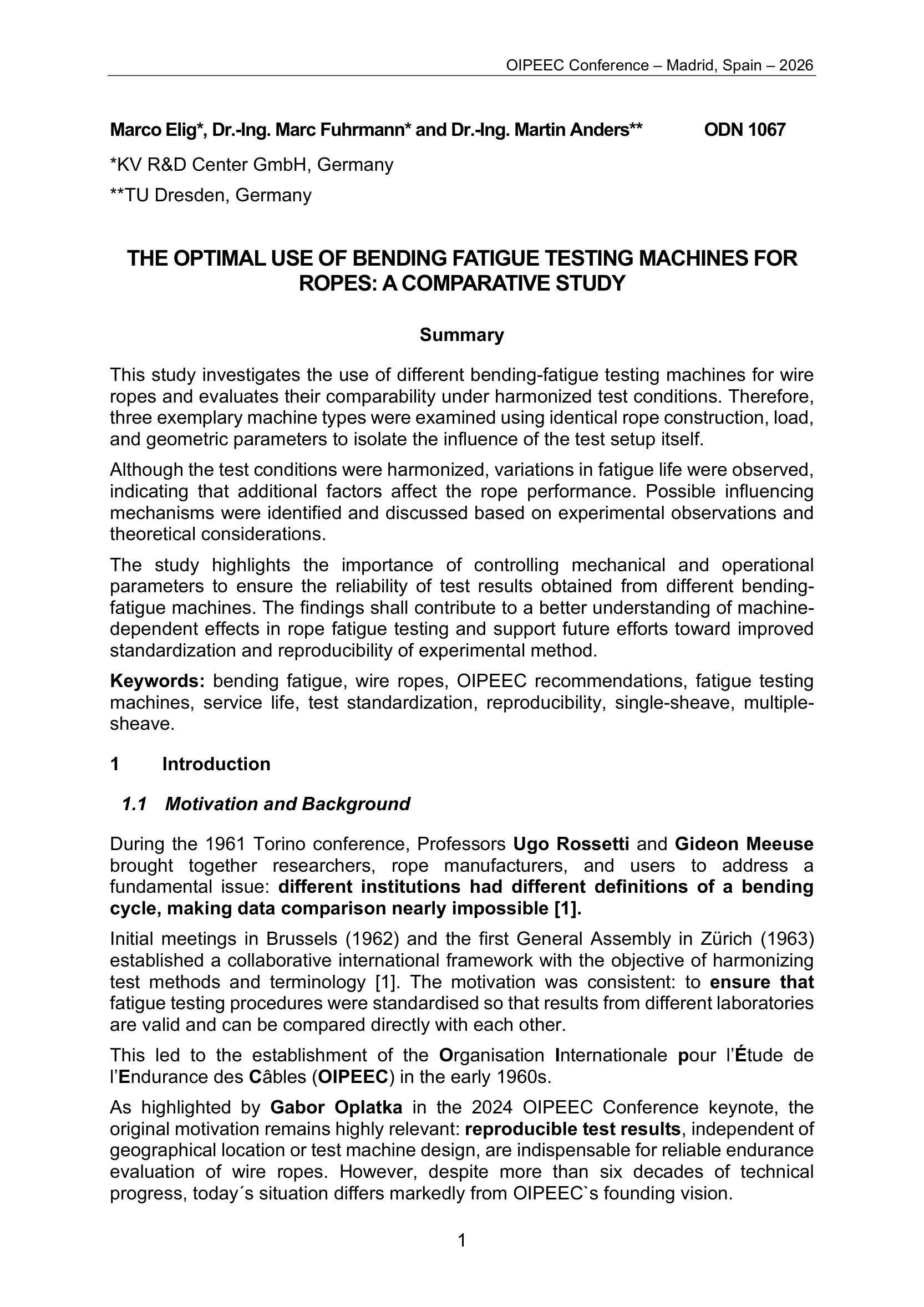
Influence of the Positioning of Plastic Sheaves and Steel Sheaves on Rope Life
How many steel sheaves are actually required to reliably detect the discard condition of a wire rope? The follow-up study "Influence of the Positioning of Plastic Sheaves and Steel Sheaves on Rope Life and Service Life" examines this question using extended bending fatigue tests and a second rope series. The results confirm that increasing the proportion of steel sheaves reduces rope service life, while improving the reliable detection of discard criteria. At the same time, the study shows that not only the position but also the minimum number of required steel sheaves depends on the specific rope construction. For a safe and service-life-optimized design of reeving systems, it is therefore essential to consider the rope type, sheave material, and sheave arrangement together.
Authors
Marco Elig, KV R&D Center GmbH, Contwig Germany
Dr.-Ing. Marc Fuhrmann, KV R&D Center GmbH, Contwig Germany
2024
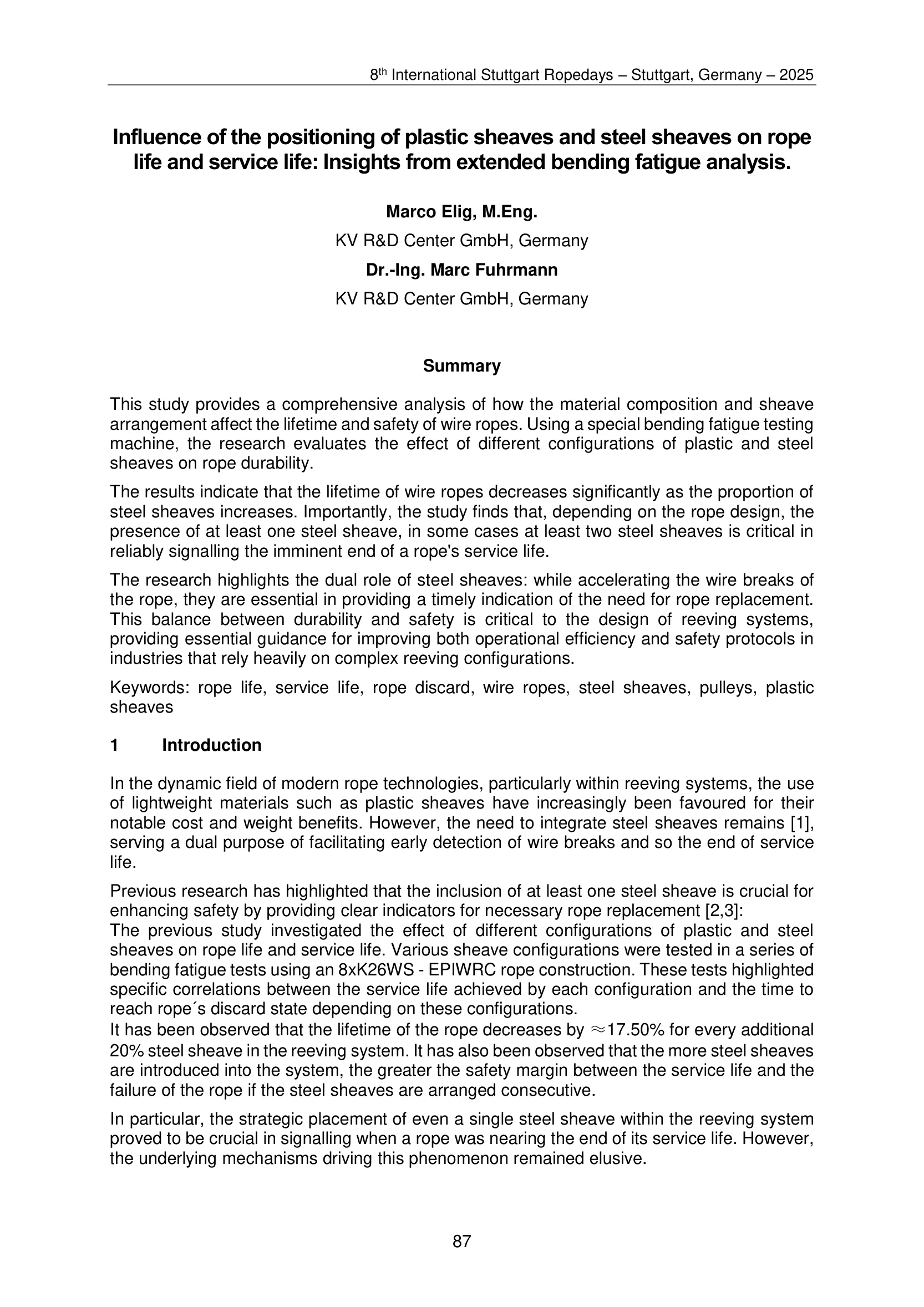
The Influence of the Position and Number of Steel and Plastic Sheaves on the Service Life and Lifetime of Wire Ropes
Plastic sheaves offer significant advantages in terms of weight, cost, and rope service life. However, they also change the damage characteristics of a wire rope. The paper "The Influence of the Position and Number of Steel and Plastic Sheaves on the Service Life and Lifetime of Wire Ropes" systematically investigates how the number and position of steel and plastic sheaves affect bending fatigue resistance, discard condition detection, and remaining service life. The tests show that plastic sheaves can significantly extend service life, while correctly positioned steel sheaves enable earlier detection of discard criteria. The determining factor is not only the proportion of steel sheaves but also their position within the reeving system. The study therefore provides valuable insights for the safe and service-life-optimized design of modern rope drive systems.
Authors
Marco Elig, KV R&D Center GmbH, Contwig Germany
Yeonhwan Bae, Kiswire Ltd., Suyeong-gu, Busan, 48212 Korea
2024
THE INFLUENCE OF THE COMBINATION OF STEEL AND PLASTIC SHEAVES ON THE OPERATING LIFE AND SERVICE LIFE OF WIRE ROPES
Plastic sheaves can significantly increase the service life of wire ropes. At the same time, however, the type and visibility of resulting damage changes.
The study "The Influence of the Combination of Steel and Plastic Sheaves on the Operating Life and Service Life of Wire Ropes" systematically investigates how the material, number, and position of sheaves influence fatigue behavior.
The tests demonstrate that systems using only plastic sheaves can increase the life to failure by a factor of 2.61 and the time to discard condition by a factor of 5.40. At the same time, even a correctly positioned steel sheave can significantly improve the detectability of discard criteria and therefore enhance operational safety.
For an optimal design, not only the sheave material but also its targeted arrangement within the entire reeving system is crucial.
Authors
Marco Elig, KV R&D Center GmbH, Contwig Germany
Dr.-Ing. Marc Fuhrmann, KV R&D Center GmbH, Contwig Germany
Yeonhwan Bae, Kiswire Ltd., Suyeong-gu, Busan, 48212 Korea
2022
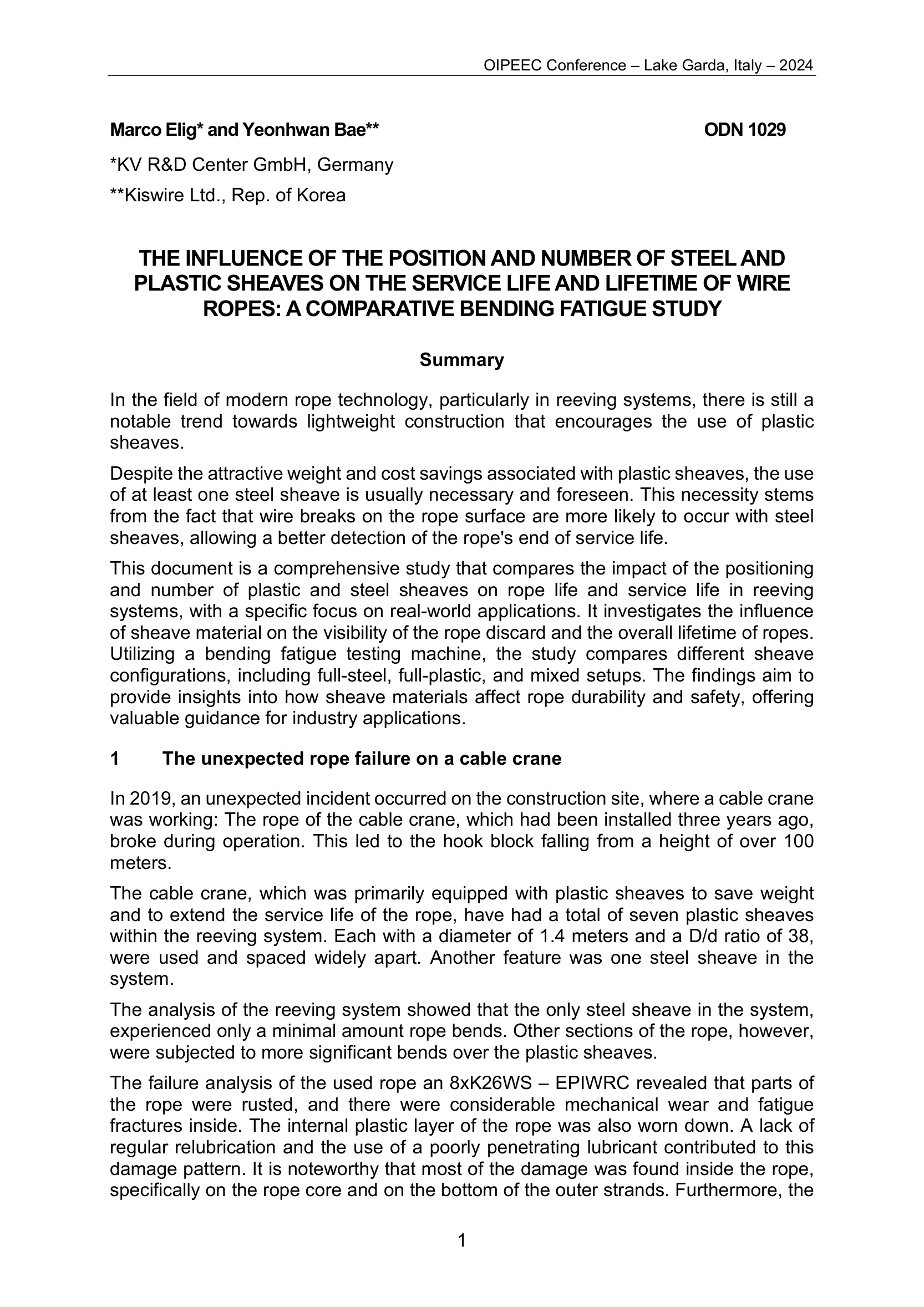
A Mechanical Model for Compaction of Strands for Wire Ropes
Compacted strands have become an essential component of high-performance wire rope constructions. The paper "A Mechanical Model for Compaction of Strands for Wire Ropes" presents a new numerical approach for modelling the compaction process and its influence on subsequent mechanical behavior. By combining an efficient 2D compaction model with a subsequent 3D simulation, geometric changes and plastic deformations can be represented in a realistic manner. The result is a powerful tool for the virtual development and optimization of modern wire rope constructions.
Authors
Li Chen, Université de Luxembourg
Marco Magliulo, Kiswire International S. A., Bettembourg Luxembourg
Marco Elig, KV R&D Center GmbH, Contwig Germany
Lars A.A. Beex, Université de Luxembourg